From our master grammarian & resident logophile, Angstrom Dickinson:
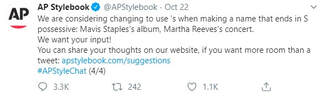
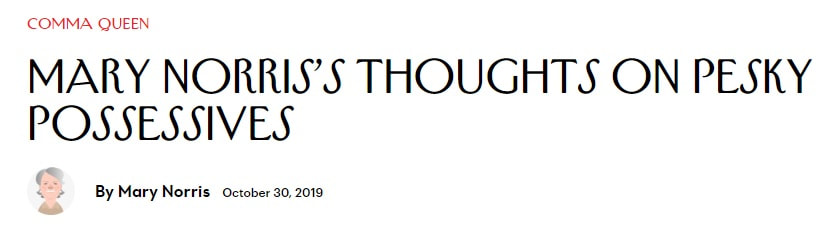
I did not see the AP Stylebook's tweet on 10/22 (below left). Instead, I saw Mary Norris' tweet (or is it now "Mary Norris's tweet"?) about "pesky possessives" (below right), and that is when I first learned that the AP is "considering changing the use of 's" for singular possessives for names that end in S. To read Ms. Norris' article (or Ms. Norris's article), click HERE.
I did not see the AP Stylebook's tweet on 10/22 (below left). Instead, I saw Mary Norris' tweet (or is it now "Mary Norris's tweet"?) about "pesky possessives" (below right), and that is when I first learned that the AP is "considering changing the use of 's" for singular possessives for names that end in S. To read Ms. Norris' article (or Ms. Norris's article), click HERE.
 |  |
This is not the first time the AP has considered such a change. Back in 1869, they considered adding 's to singular possessives with names that end in S at the request of President Ulysses S. Grant. At that time, Emmett Lee Dickinson wrote a short poem about the ensuing controversy, "Peril of a Possessive" (below on the left). Dickinson's poem inspired third cousin Emily to pen her poem "Peril as a Possession" (below on the right).
| By Emmett Lee Dickinson: Peril of a Possessive 'Tis Hard to bear The Press* associates Apostrophe With Ss there – Begets an awe That stretches Common Sense’s limits The same as Decaf *The Associated Press | By Emily Dickinson: Peril as a Possession 'Tis Good to hear Danger disintegrates Satiety There's Basis there -- Begets an awe That searches Human Nature's creases As clean as Fire. |
 RSS Feed
