From Lemuel Stuart III:
BREAKING NEWS: Roswell Kedgick, the general manager of the Washerst Cinémathèque Downtown Mutliplex at Dickinson Square Mall in historic Washerst, Pennsylvania, the birthplace of America’s greatest poet, Emmett Lee Dickinson (Emily Dickinson’s third cousin, twice removed – at her request), announced that the theater has obtained the only surviving copy of Alfred Hitchcock’s horror-thriller film “The Bards.”
Set in the quaint town of Amherst, Massachusetts, “The Bards” focuses on the volatile relationship between Emily Dickinson and her third cousin, Emmett Lee, during a series of sudden and unexplained violent attacks by other famous American poets.
BREAKING NEWS: Roswell Kedgick, the general manager of the Washerst Cinémathèque Downtown Mutliplex at Dickinson Square Mall in historic Washerst, Pennsylvania, the birthplace of America’s greatest poet, Emmett Lee Dickinson (Emily Dickinson’s third cousin, twice removed – at her request), announced that the theater has obtained the only surviving copy of Alfred Hitchcock’s horror-thriller film “The Bards.”
Set in the quaint town of Amherst, Massachusetts, “The Bards” focuses on the volatile relationship between Emily Dickinson and her third cousin, Emmett Lee, during a series of sudden and unexplained violent attacks by other famous American poets.
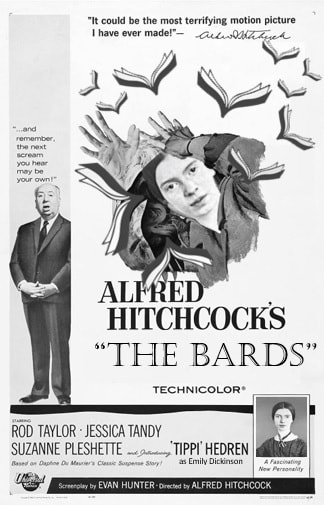 | 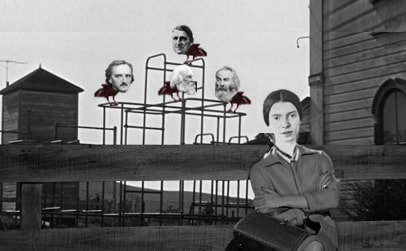 The movie stars Rod Taylor as Emmett Lee Dickinson, Tippi Hedren as Emily Dickinson, and Suzanne Pleshette as Mable Loomis Todd. Others in the film are Danny Devito as Edgar Allan Poe, David Letterman double-cast as Walt Whitman and Henry Wadsworth Longfellow, Conan O’Brien as Ralph Waldo Emerson, and a cameo appearance by Kate McKinnon as Henry David Thoreau. “We’ll play the movie on multiple screens once this **insert your favorite poetic expletive here ** pandemic ends,” said Kedgick. |
In the meantime, if you’re in the mood for Hitchcock, check out our recent special exhibit, “March Madness with Alfred Hitchcock,” HERE.





 RSS Feed
