|
We've adopted a kitten from the SPCA (Society of Poetic Cats of America). Her name is Emily -- and yes -- she writes poetry. Are you too deeply occupied to say if her Verse is alive?
0 Comments
Ten - nine - eight - seven - six - five - four - three - two - one… HAPPY NEW YEAR! Well…it’s a new year of sorts, a new year of daily Dickinson posts! I started with my first post on CounterSocial back in November 2022, and the initial post centered on Dickinson’s love of birds – and how she referred to them as “nature’s little poets.” Of course, this is post number 965, and three years later should put me at about 1,100, but the discrepancy is due to my travels; since I don’t hit the road with all my Dickinson references, I always put my daily posts on pause. [NOTE: This plog (poetry blog) on this site, TheDickinson-dot-net, dates back to 2013. Later, in 2022, I deleted my Twitter account when Melon Husk took over, and allowed for the proliferation of hate speech and disinformation, and I joined Counter Social --- and that's where I began my current series of #DickinsonDaily posts. I also now post them on Tumblr and Substack -- as of this past February.] Here we are three years later, so let’s return to Dickinson’s love of birds. Dickinson used the word “bird” in 148 poems, and of course, she mentioned specific birds in many of her poems. Which was her favorite? Any guesses? Some birds never made the cut. There are no poems which use the words “canary,” “chickadee,” “chicken,” “crane,” “duck,” “egret,” “Finch,” “gull,” “hawk,” “heron,” “ibis,” “parrot,” “pigeon,” “raven,” “starling,” “stork,” “turkey,” or “woodpecker.” However, in the case of “woodpecker,” she never used the word, but wrote a poem about the bird. Mabel Loomis Todd titled this poem “The Woodpecker” when she published it in the third series of Dickinson’s “Poems” in 1896: His Bill an Auger is His Head, a Cap and Frill He laboreth at every Tree A Worm, His utmost Goal. What birds did “make the cut”? Here are birds in Dickinson’s poems, and the number of poems in which they appear: Blackbird: 1 Peacock: 1 Whippoorwill: 1 Cardinal: 2 Dove: 2 Eagle: 2 Owl: 2 Vulture: 2 Wren: 2 Hummingbird: 3 Swan: 3 Oriole: 4 Lark: 5 Crow: 6 Sparrow: 7 Jay: 8 Okay, so what bird takes top honors as the avian most often mentioned in the poetry of Emily Dickinson?
Appearing in 31 poems, “The Robin is the one!” Recent posts have been about two of Dickinson’s bird poems, “The Birds begun at Four o’clock” and “At Half past Three, a Single Bird”; click the post titles below to access them: 9/10: The Poetry & The Ecstasy 9/11: Inspiration Point 9/12: The Circle of Life 9/13: Paint Remover Below are additional links related to these posts that you might find interesting. 1. A two-minute podcast of bird songs – AND – a recitation of “The Birds begun at Four o’clock," is HERE. 2. A review of Brenda Wineapple’s book White Heat, The Friendship of Emily Dickinson and Thomas Wentworth Higginson, mentioned in the posts from 9/10 and 9/11, can be found HERE. 3. Check out this page for interesting connections to “At Half past Three, a single Bird,” including recitations and songs, HERE. 4. A painting by Marc Chagall called “Half Past Three” is HERE (this is not related to the poem at all; I just found it interesting). 5. An interesting article, "Better Than a Million Words": Avian Symbology in the Poems of Emily Dickinson,” by Hannah Arnold, can be found HERE. 6. Check out this site, “The Emily Project’; it makes a connection between Dickinson’s “At Half past Three” poem and a poem by Wallace Stevens, HERE.
Both “The Birds begun at Four o’clock” and “At Half-past Three, a single Bird” impart human-like creative spirit to birds, and it is likely the poems were autobiographical with birds as symbol of the poet herself. Her very poems were the “cautious melody,” written in private, not “for applause” – “but Independent Ecstasy.” The poems also touch on the relationship between creator and their creation. Of course, “At Half past Three, a single Bird” concludes with the enigmatic lines, “And Place was where the Presence was / Circumference between”; yesterday I puzzled over Dickinson’s use of “circumference” – especially with that added modifier, “between.”
In his essay "Dickinson's at Half Past Three, a Single Bird,” author Michael Bird put forth that Dickinson’s use of “circumference” incorporated the idea that once a work is created, it takes on an independent life, separate from its creator. He also referenced other critics who saw "circumference" as both a barrier and a way to expand comprehension. (Hmm. “Circumference” as contranym?) Thomas Wentworth Higginson’s essay “Water-Lilies” seems to have been the inspiration for both of these poems. As a matter of fact – and in a move highly unusual for Dickinson – she even used Higginson’s exact words to open the one poem, “At Half past Three.” Dickinson was very well read and intelligent, and at her core, a creative being, inspired by all facets of her life. It would seem near impossible for her not to have reacted or responded to what inspired her. However, inspiration is not the same as imitation. While it may well be an intrinsic challenge to create or transform influences into something unique, Dickinson was always authentic to her own voice and style. In her article “Emily Dickinson Parallels” in The New England Quarterly, author Mary Elizabeth Barbot said this: “That she ever consciously plagiarized with serious intent is irreconcilable with her fine sense of integrity, evidenced by a scrupulous acknowledgment in a letter to Higginson: ‘I marked a line in one verse, because I met it after I made it, and never consciously touch a paint mixed by another person.’ That she sometimes unconsciously used others' ideas or phrases which had been absorbed into the rich depth of her mind appears evident; but always these ‘echoes’ bear unmistakably the characteristic stamp of her original style.” I have composed original songs based on some of Dickinson’s poetry, and a few years back I wrote a particularly lovely melody for the poem “I never saw a moor.” However, once I put the chord progression I heard in my mind to paper and then played it, I realized that I had simply written an updated version of Pachelbel’s Canon in D. What can I say? Unconsciously using something which has been absorbed into the rich depth of one’s mind happens. BTW: I also set “I felt a funeral in my brain” to the chords and melody to “A Whiter Shade of Pale,” but I set out purposely to do that. One last word about “At Half past Three, a single Bird”: Dickinson sent a copy to friend Doctor J. G. Holland. Holland and his wife were frequent correspondents and intimate family friends with the poet, and I wonder if she sent this particular poem to him due to the scientific references in the poem. Michael Bird pointed out in his essay that Dickinson used the word "Experiment" in the second stanza to describe the bird's song, suggesting that the creative process was not just an artistic act but also a form of testing and searching, much like scientific inquiry. Thoughts? I’ve been discussing “The Birds begun at Four o’clock” for the past couple of days, and yesterday – with info from Brenda WIneapple’s book “White Heat, The Friendship of Emily Dickinson & Thomas Wentworth Higginson” -- I noted the possibility that Dickinson may have been inspired to write the poem after reading Thomas Wentworth Higginson’s essay entitled “Water-Lilies.” “Water-Lilies” first appeared in “The Atlantic” in 1858 and later in his 1863 collection of essays called “Out-Door Papers.” We know that Dickinson read Higginson’s book – she praised him for it in a letter from 1876 – and she very well might have seen the stand-alone essay in “The Atlantic.” Today, I will share a second work inspired by Higginson’s words as well. A paragraph deep in Higginson’s1858 essay begins with this line: “Precisely at half past three, a song-sparrow above our heads gave one liquid trill….” Then, in 1863 – the year of publication of Higginson’s book – Dickinson wrote “The Birds begun at Four o’clock.” Two years later she wrote this poem – and take note of the first line: At Half past Three, a single Bird Unto a silent Sky Propounded but a single term Of cautious melody. At Half past Four, Experiment Had subjugated test And lo, Her silver Principle Supplanted all the rest. At Half past Seven, Element Nor Implement, be seen – And Place was where the Presence was Circumference between. It seems very likely that Higginson’s essay inspired this poem. Just as he opened his paragraph with a lone sparrow’s “sudden and delicious” trill, Dickinson begins her work with a solitary bird’s “cautious melody” – and both are at the exact same time, half-past three. On the surface, Dickinson’s poem sounds very clinical and scientific, with words such as “experiment,” “test,” “element,” “implement,” and “circumference.” Beneath the surface, though, the lines seem to explore the creative process itself. Is this bird a representation of Dickinson herself (she did, after all, call birds “nature's little poets”), and are her poems her “cautious melody”? There is a possible hint about this in the final stanza when, several hours later, the bird and melody are no longer present: “And Place was where the Presence was / Circumference between.” What do you make of that penultimate word, “Circumference”? The “Place” where the “Presence” of the bird and melody had been, is now – at the end of the poem – restored to its original nature (no pun intended? Maybe?) Therefore, is “Circumference” used solely to signify all that is within the bounds and scope of that place? Or does it mean something more? That word “between” seems to convey some sort of added dimension (oddly enough for me, it calls to mind the opening lines of Franklin 373 – though the word “circumference” is not even used: “This World is not conclusion / A Species stands beyond / Invisible, as Music / But Positive, as sound”). Dickinson used the word “circumference” in 17 different poems, but take a look at the Dickinson Lexicon entries for her uses of the word. There are 13 of them – and they include so much more than just the basic meaning of the word, the perimeter of a circular boundary. Plus – and this takes me back to that possible autobiographical connection within this poem – Dickinson disclosed to Higginson in her fourth letter to him, “My Business is Circumference.”
What do you think? More on this tomorrow. Stay tuned. Yesterday’s post focused on Dickinson’s “The Birds begun at four o’clock,” a simple but profound work that highlights a daily, ordinary moment often overlooked by all “except occasional man.” The poem truly conveys a sense of wonder and the sublime. In her book “White Heat, The Friendship of Emily Dickinson & Thomas Wentworth Higginson,” Brenda Wineapple suggests that Dickinson may have been inspired to write this poem – and certainly another similar poem (which I’ll share tomorrow) – after reading a passage from Thomas Wentworth Higginson’s first book “Out-Door Papers” (1863), a collection of his essays from “The Atlantic.” In his essay “Water-Lilies,” Higginson wrote the following: We know that Dickinson read Higginson’s book because she mentioned it in a letter to him in the spring of 1876:
It is still as distinct as Paradise - the opening your first Book - It was Mansions - Nations - Kinsmen - too- to me – How about that for praise? And by the way, speaking of Dickinson’s “Kinsmen,” she wrote in letter to Higginson in April 1862, “You ask of my Companions Hills- Sir-and the Sundown-and a Dog-large as myself, that my Father bought me-They are better than Beings-because they know-but do not tell-and the noise in the Pool, at Noon.” In a letter from July that same year, Dickinson wrote, “I know the Butterfly-and the Lizard-and the Orchis - Are not those your Countrymen?” These passages call to mind two things: First, her use of the word “Pool” in the line about her dog calls to mind a similar use of the word at the end of line 13 in “The Fingers of the Light”; I shared that poem a couple of days ago, HERE. Second, the mention of the Orchis seems to anticipate lines in her letter from spring 1876 (the one where she mentioned Higginson’s book); she concludes that letter with this: ”I had long heard of an Orchis before I found one, when a child, but the first clutch of the stem is as vivid now, as the Bog that bore it- so truthful is transport….” More about this – and that other similar poem – tomorrow. Stay tuned. I’m an early riser, so I’m often up before sunrise. Of course, our cats love it, because it means a timely breakfast for them. slices on hand).
What a wonderful poem!
The birds start early as the sun makes its ascent during those periods of dawn where light steadily diffuses; and then – check out lines 3 and 4 – “A music numerous as space / But neighboring as Noon.” I mean, how incredible is that? An amplitude of sound as large as space itself, yet as friendly as a neighbor’s chat at noon. “I could not count their Force,” admitted Dickinson, as their voices spread as tributaries flow upon one another to “multiply the Pond.” Again, I ask – how incredible – and perfect – is that? And that just takes us to line 8, the poem is just getting started! Needless to say, there are few, if any, witnesses to this daily performance (“Except occasional man” – and I am fortunate, often, to be such a one), so why do the birds do it? It’s not for applause. Nope. It’s all just for “independent Ecstasy.” I’m blown away. Later – as the poem progresses – at that time when sunlight has “engrossed the East,” the “flood” is done, the band is gone, the day moves on. This daily miracle is all but forgotten (this calls to mind the quotidian nonchalance of those who ignore sunsets in “The largest Fire ever known,” discussed HERE. I love this poem’s focus on the natural world and the interplay between human and animal experience, and I love Dickinson’s ability to imbue ordinary moments with a sense of wonder and the sublime (Once again, allow me to quote Dickinson scholar Julia Hejduk: Dickinson is “a poet of incarnation—of the small, concrete, and quotidian becoming a vessel for the infinite”). Back in 1890, an early reader of the first edition of Dickinson’s poetry wrote to editor Mabel Loomis Todd and compared Dickinson to another popular poet of the day, J. Whitcomb Riley. Riley, he said, “merely helps us see the things without doing much to help us see into them.” That is certainly not the case with Emily Dickinson. More on this poem tomorrow. What do you call the sound produced by something striking water? Okay, before I get to that, my recent posts have explored Dickinson’s use of the words “house” and “home,” and one other poem with “home” I’d like to share is “A Bird came down the Walk.” It’s a thoroughly delightful poem about a bird – and Dickinson describes all the business of that bird as he walked his daily beat. There are so many wonderful images in the poem – the Angle Worm (RIP), the convenient Grass, the sideways hop, the Beetle, the rapid eyes (like frightened Beads), and his Velvet head – just to name a few. The final lines are described by poet and critic Helen Vendler as follows: “Dickinson puts all her charm to work at the end of the poem, stifling both savagery and fear in the opulence of her ‘oh’ sounds, accompanied by alliterating phrases: ‘rolled . . . rowed .. . Home ... Oars . . . Ocean;' followed by her light ‘silver .. . seam’ and her buoyant ‘Butterflies, off Banks of Noon.’ In the synthesizing Dickinsonian imagination, the ocean's fish, which swim with splashing sounds, are by the one word ‘plashless;' metamorphosed into a swarm of silently moving butterflies.” One doesn’t come across the word “plash” all that often – at least I don’t – and “plash” is the sound produced by liquid striking something or being struck. Dickinson used a form of the word in three poems: Plashless: A Bird came down the Walk Plashing: A Prison gets to be a friend Plash: I’ve known a heaven like a tent About this poem Franklin wrote, “Three (one lost), variant, about summer 1862. The lost manuscript was sent to T. W. Higginson, probably in the fifth letter to him, written about August 1862. Higginson listed it for Mabel Todd on 13 May 1891 as one of the poems he had received…and he published it in the October 1891 issue of the Atlantic Monthly.”
I’ll have some follow-up on this tomorrow. Recent #DickinsonDaily posts were about Dickinson’s poems about bees which led me to her poems which use the word “amen” and that brings me today to her poems with the word “Bobolink” (one of which, by the way, does not use “amen” but does include “amenable”); info on that is HERE. The poem with “amenable” is “The Way to know the Bobolink” – and just FYI: In case you’re wondiering “what in the world is a Bobolink,” it’s a bird; Wikipedia states, the Bobolink is “a small New World blackbird and the only member of the genus Dolichonyx. An old name for this species is the ‘rice bird,’ from its tendency to feed on cultivated grains during winter and migration.” More info on the Bobolink can be found HERE. Dickinson wrote 14 poems which mention the Bobolink, and this one, “The Way to know the Bobolink” is one of my favorites. It is a wonderful ode to the bird. I love the first four lines – wouldn’t you love to associate with people who are like this opening description of the bird – The Way to know the Bobolink / From every other Bird / Precisely as the Joy of him / Obliged to be inferred.” And then lines 5 & 6 – yet another example of Dickinson’s writing which reflects both the whimsical and erudite nature of the poet: “Of impudent Habiliment / Attired to defy.” I mean, who do you know that uses the word “habiliment” – but it’s the perfect word – and to me, the use of the word does not seem to reflect any sort of intellectual snobbery. And lines 15 and 16 – what a remarkable tribute to the bird: “He compliments existence / Until allured away.” Again, do you know others who “compliment existence”? LOL – I want to hang around people like that! BTW: That line – that the Bobolink “compliments existence” calls to mind for me Frank Lloyd Wright’s view on cows. In his autobiography, Wright – who grew up on a farm in Wisconsin – wrote, “Why is any cow, red, black or white, always in just the right place for a picture in any landscape? Like a cypress tree in Italy, she is never wrongly placed. Her outlines quiet down so well into whatever contours surround her. A group of her in the landscape is enchantment.”
Oh, BTW: Check out the “Dickinson’s Birds: A Listening Machine” project; you can click the link below and hear a Bobolink, HERE.
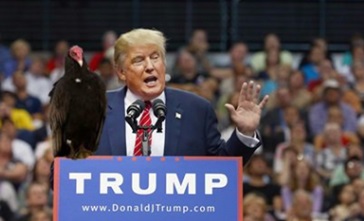
The Twitterverse has been abuzz lately all because a couple of birds -- one that landed on a podium at a Sanders' rally, and another at an event for Trump. As a result, birds have been covered by the media more than when Alfred Hitchcock released his magnum opus about the creatures. All of the news coverage and the multitude of Twitter tweets reminded us of a now-classic poem by Emmett Lee Dickinson (Emily Dickinson's third cousin, twice removed -- at her request) called " Upon his Lectern sprung a Bird" (below on the left). His poem inspired third cousin Emily to pen her poem "Upon his Saddle sprung a Bird" (below on the right).

|
Archives
December 2025
PLOGA poetry log for the Emmett Lee Dickinson Museum (above the coin-op Laundromat on Dickinson Boulevard in historic Washerst, Pennsylvania). Categories
All
|
RSS Feed