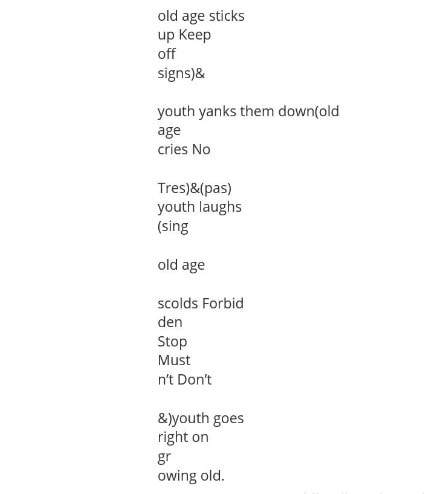
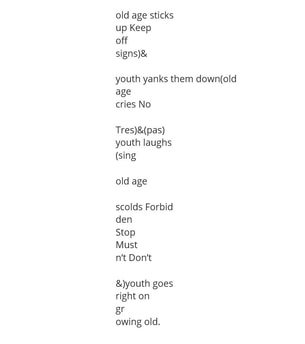
 | The other day I posted E. E. Cummings’ poem “old age sticks" (HERE), a poem about generational conflict, and I’ve been talking about how creative souls push the boundaries in various fields of fine arts, like poetry and art – people like E. E. Cummings (and just BTW, one thing I LOVE about “old age sticks” is how the two final words, “growing old,” are split so that they also say “owing old” – as one generation owes the previous one for being “agents of change”). This morning I ran a Google-search on “who pushed the boundaries in the field of poetry.” I just wanted to see what names might pop up – but I got a whole mix of responses, none of which (at least at first glance) had much to do with what I was looking for. One article called, “Re-cognition and Re-vision: Pushing the Boundaries of Poems” turned out to be a solicitation for an online poetry writing class. However, it began with this statement: “Writers often place a hard line between the acts of writing and revising. While the first is seen as an act of joyful inspiration, the second is generally viewed as drudging perspiration.” I mention this because as I sit here this morning typing on all of these topics (poetry, art, boundary pushing – “growing old,” “owing old” – agents of change, etc.) my brain is shooting off in many directions, so what you are reading is entirely the result of mental meanderings vs. any “drudging perspiration.” |
Yesterday I gave a homework assignment (HERE): Listen to John Cage’s piano piece, 4’ 33”. Plus at some point these past few days, I mentioned R. Mutt’s (aka Marcel Duchamp’s) sculpture “Fountain.”
I cited those two works to make the point that some who push boundaries do so to make a point. Others (like Dickinson) push boundaries because it’s within them – it’s who they are.
Look at this info about Georgia O’Keefe:
“Georgia knew from the age of 12 that she wanted to be an artist. She went to art school but what she was taught there didn’t seem relevant to the way she wanted to paint. Then in 1912 she discovered the revolutionary ideas of an artist and designer called Arthur Wesley Dow.
As O’Keeffe explained: ‘His idea was, to put it simply, fill a space in a beautiful way’. This was a light-bulb moment for her and from then on she began to experiment with shapes, colours and marks.”
And this story of O’Keeffe and Dow (with which name are you familiar?) reminded me of Vachel Lindsay and Langston Hughes (with which name are you familiar?). I’ll get into that tomorrow.
I cited those two works to make the point that some who push boundaries do so to make a point. Others (like Dickinson) push boundaries because it’s within them – it’s who they are.
Look at this info about Georgia O’Keefe:
“Georgia knew from the age of 12 that she wanted to be an artist. She went to art school but what she was taught there didn’t seem relevant to the way she wanted to paint. Then in 1912 she discovered the revolutionary ideas of an artist and designer called Arthur Wesley Dow.
As O’Keeffe explained: ‘His idea was, to put it simply, fill a space in a beautiful way’. This was a light-bulb moment for her and from then on she began to experiment with shapes, colours and marks.”
And this story of O’Keeffe and Dow (with which name are you familiar?) reminded me of Vachel Lindsay and Langston Hughes (with which name are you familiar?). I’ll get into that tomorrow.







 RSS Feed
