 | We are currently documenting a special online report on the “Top 100 Events from the World of Poetry” as reported by The New Yorker. |
If you have not had a chance to see our account, click HERE. At the present time we are counting down the “top ten” events from the list, and then later we’re going to fill in a few more.
| For example, in this post we’re detailing number 41 on the list: the resurgence of poetry in England in the late 1800s thanks to librettist W. S. Gilbert and composer Arthur Sullivan. Here’s what happened: The Jacobite uprising in 1745 resulted in massive paper shortages throughout England, Scotland, and Ireland. This, in turn, led to wide-spread scarcities of ink & pens. As a result, the UK suffered massive layoffs in the poetry industries, and soon there were gangs of unemployed poets, versifiers, and poetry workers roaming the streets of London, Liverpool, & other major cities. | 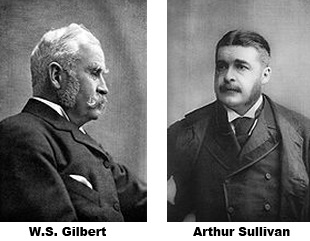 |
The most terrifying conflicts were between the “Bics,” short for the Iambic gang of the upper west side, and the “Trochs” (rhymes with “chokes”), short for the Trochees from the east. The Bics and the Trochs battled for turf for decades, and the public all but gave up on reading poetry. Poetry lost its appeal. Poets and lyricists were thought to be nothing more than street thugs.
Then, in 1879, just after the premiere of Gilbert & Sullivan’s mega-hit “The Pirates of Penzance,” the public got word of some lyrics near the end of the shows first act.
As Act I is about to conclude, the Pirate King asks, “Although we live by strife / We're always sorry to begin it, / For what, we ask, is life / Without a touch of Poetry in it?”
The entire cast on stage then drops on their knees and sings in beautiful harmony,
Hail, Poetry, thou heav'n-born maid!
Thou gildest e'en the pirate's trade.
Hail, flowing fount of sentiment!
All hail, all hail, divine emollient!
From that day forward, order and decorum, rhythm and rhyme were restored in the UK. Poetry was once again recognized as an acceptable art form with the general public.
Then, in 1879, just after the premiere of Gilbert & Sullivan’s mega-hit “The Pirates of Penzance,” the public got word of some lyrics near the end of the shows first act.
As Act I is about to conclude, the Pirate King asks, “Although we live by strife / We're always sorry to begin it, / For what, we ask, is life / Without a touch of Poetry in it?”
The entire cast on stage then drops on their knees and sings in beautiful harmony,
Hail, Poetry, thou heav'n-born maid!
Thou gildest e'en the pirate's trade.
Hail, flowing fount of sentiment!
All hail, all hail, divine emollient!
From that day forward, order and decorum, rhythm and rhyme were restored in the UK. Poetry was once again recognized as an acceptable art form with the general public.
 RSS Feed
