Yesterday’s post had a school-related theme, so let’s continue with that, shall we? Yes, we shall. Let’s take out our poetry books and turn to the Table of Contents.
| Sooo…yeah…I happened to be subbing as admin in a high school the other day, an IB school (i.e., International Baccalaureate), and I stopped into an English classroom to see what Dickinson they had on hand. There were two books with works by and/or about the Belle of Amherst.  |  First, a poetry book edited by Michael Myer included a number of poems by Dickinson (shown below left with the red arrow), and I also spied what I thought was an essay entitled “The Deconstruction of Emily Dickinson” by one Galway Kinnell (marked with the blue arrow). |
 | However, that turned out to be a memoiric poem (Hmm…is “memoiric” a word? Who you gonna believe, AI…or the OED?)...   ...akin to a diary entry somewhat related to l’esprit de l’escalier (i.e., "staircase wit”) – that phenomenon where, once a chat is over, your brain replays the event, your nervous system calms down, and you find the right words to as “what I should have said.” In this case, though, the speaker in the poem seems to have formulated “what I should have said” in the moment – but chooses to be diplomatic, so to speak, in order to match (perhaps) “how she felt” (“she” being Dickinson). |
Below: Kinnell's "memoiric" poem. Click the images to enlarge -- OR -- you can also read it HERE.
 |  |  |
Four things about all of this:
| First, the poem (which I loved) called to mind a very short poem I wrote entitled “Unspoken Words.”  | Second, the line “the hidebound response of literary men” pairs nicely with one of my recent posts about early reviews of Dickinson's work, HERE. Plus, “the gulf between the poetic wishfulness / then admired” called to mind this post about a poem by Thomas Bailey Aldrich, HERE – a sappy poem, now completely outmoded, but “then admired.” Also, the lines about the “admired” grandiloquent, stodgy poetry of the 9th century “let her see that her poems / would not be understood in her time” is so freakin' true. In April 1862 Dickinson responded to a letter from Higginson in which he had commented on four poems she had sent him. Dickinson said of his critique, “Thank you for the surgery – it was not so painful as I supposed. I bring you others – as you ask – though they might not differ –”. In June 1862, she followed with, “You think my gait ‘spasmodic’ – I am in danger – Sir – You think me ‘uncontrolled’ – I have no Tribunal." However, over time, Dickinson showed no effort or desire to adjust her style. She knew what she was up to. |
| Third, I referred to Kinnell’s work as “memoiric,” though that is completely assumptive. In July 1862, Dickinson wrote to Higginson, “When I state myself, as the Representative of the Verse – it does not mean – me – but a supposed person.” Could that be the case with Kinnell as well? Finally, when I was exploring the “what I should have said” phenomenon, I stumbled upon this – the Muppets’ “Phenomenon Sketch” with Sandra Bullock (watch HERE). Now I can’t stop singing “Mahna Mahna.” |  |


| The other textbook with reference to Dickinson was An Introduction to Poetry, edited by X. J. Kennedy and Dana Gioia, an anthology focusing on how to read, analyze, and write about poetry. This book included Cynthia Griffin Wolff’s essay, “Dickinson and Death” – well, perhaps an essay? An excerpt? After the title it says, “A Reading of ‘Because I could not stop for Death,” page 337; and then at the conclusion it says, “From Emily Dickinson” – so likely an excerpt from that. |  |  |
Below left to right: The essay/excerpt -- likely from Wolff's book on the far right.
 |  |  |
Interestingly, I also spied the name “Alfred Hitchcock” in the index, so as an ardent Hitchcock fan, I had to check out what that was all about. The paragraph that mentions Hitchcock (below on the right) reads as follows:
| "The special power of poetry comes from allowing us to hear simultaneously every level of meaning in language – denotation and connotation, image and idea, abstract content and physical sound. Since sound stress is one of the ways that the English language most clearly communicates meaning, any regular rhythmic pattern will affect the poem’s effect. Poets learn to use rhythms that reinforce the meaning and the tone of a poem. As film directors know, any movie scene’s effect can change dramatically if different background music accompanies the images. Master of the suspense film Alfred Hitchcock, for instance, could fill an ordinary scene with tension or terror just by playing nervous, grating music underneath it." |  |
Three things about all of this:
First, the reference to "denotation and connotation" called to mind a post I published back in October 2025 where I mentioned an article by Dan Skoog entitled, “Making Emily Sing: Exploring the Relationship between Poetic and Musical Time in Setting Dickinson’s Poetry to Music." In his piece, Skoog quoted poet Lewis Turco who said, “if a poet strips words of their denotations and uses them for their connotations only, the poet is then writing in abstract syntax." Among other discussions in the post, I questioned if it were even possible for a poet to “strip words” of their denotations and to convey connotations only. That post is HERE.
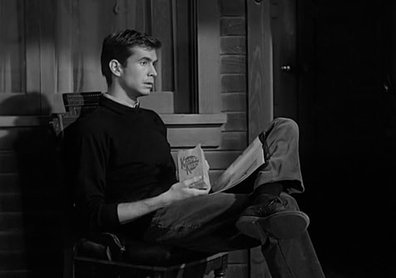
Second, you know the iconic screeching violins from the shower scene in "Psycho"? At first, Hitchcock wanted NO music whatsoever to accompany that scene. All he wanted was the sound effect of the "stabbing" -- and to accomplish that, he used a butcher knife to stab a casaba melon repeatedly (prior to production, Hitchcock listened with his eyes closed to various fruits being hacked until he heard the ideal texture -- the casaba). Listen to a discussion about his choice HERE.
 | Listen to a discussion about his melon of choice HERE. Bernard Herrmann, the composer of the renowned soundtrack, thought Hitchcock's decision was unsound (LOL -- pun intended) -- so he played the recorded track with his music alongside the edited footage. Hitchcock immediately changed his mind, calling his original preference an "improper suggestion." Info is HERE wit "How Bernard Herrmann saved Psycho. |
Third, my wife and I are attending a concert by the Baltimore Symphony Orchestra on October 30, "Psycho in Concert"! How cool is that?

| One last textbook, but not form the high school English classroom I'd visited; no, this one is from an American lit class at UVA. Here's the story: If you've read my recent posts about the 1st edition book signed by Lavinia Dickinson that I found on the library shelf at UVA, then you know I've visited the Shannon Library and the Small Special Collections Library several times in the past few weeks. On one visit, I stopped by the UVA bookstore, and spoke to one woman at the course textbook counter. I introduced myself, explained that I publish daily posts on Dickinson, and asked if any course happened to use any book on Dickinson. "Just curious," I said. She typed something into her computer, disappeared into the stacks of books, and returned with R. W. Franklin's The Poems of Emily Dickinson. She said it wasn't for a course about Dickinson, but it was for an upper-level lit class. I can only imagine there is a heavy emphasis on Dickinson if the prof requires students to purchase a volume of her "complete" poems. |  |







 RSS Feed
