I’ve been discussing issues songwriters encounter when trying to set Dickinson poems to music, and the first and foremost problem is the length of many of her poems – that is, some are so short you could end up with a 30-second song. LOL.
One way to handle this “problem” is to repeat the poem several times – and/or to embed it into another song – as I did with my melody for “I never saw a moor” and Pachelbel’s Canon (for more on this, click HERE).
One way to handle this “problem” is to repeat the poem several times – and/or to embed it into another song – as I did with my melody for “I never saw a moor” and Pachelbel’s Canon (for more on this, click HERE).
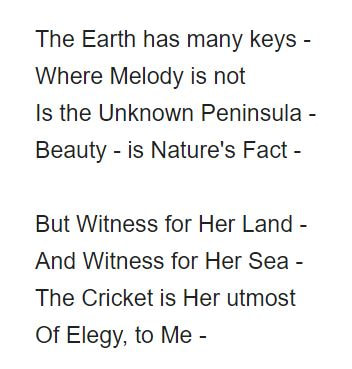 | Another way to handle the issue of short poems is just to write short song! My composition for “The Earth has many keys” clocks in at just under a minute and a half. Of course, one has to decide what type of song to write that is appropriate for the theme or mood of a given poem: Something upbeat and positive? Something slow and sad? Something mournful or something uplifting? Something inspirational or lighthearted? |
This past December a friend of mine helped me with a birthday celebration event for Emily Dickinson’s 193rd birthday. She sang my original songs based on ED’s poetry, and I played the piano. I came across the line “The Earth has many keys,” so we landed on that as the name for our event – and I decided to compose a song based on that poem. Info on our event is HERE.
My first inclination – based on the first four lines of the poem – was to write something upbeat. After all, lines 1 and 4 state, “The Earth has many keys,” (sounds happy to me) and “Beauty is nature’s fact,” and lines 2 and 3 mention – albeit a bit awkwardly – “Where melody is not / Is the unknown peninsula.”
But then I read the final four lines, and I changed my mind from writing some sort of rosy, hopeful song to composing – **drum roll please** – an elegy! Afterall, there it was in line 8, the word “Elegy.”
I read the poem with a very modern perspective with a focus on climate change: As beautiful as our planet is, we are not doing enough to protect it; witness what is going on with our land and seas (lines 5 and 6) – and the sound of crickets – signifying our silent response to all the warning signs – is the Earth’s “utmost of Elegy, to me.”
I ended up with a slow and somber melody, and the song lasts all of about a minute and twenty-seconds. Oh, I also challenged myself to change keys when possible (since the first line is “The Earth has many keys”) – so not an easy task with such a short composition.
My first inclination – based on the first four lines of the poem – was to write something upbeat. After all, lines 1 and 4 state, “The Earth has many keys,” (sounds happy to me) and “Beauty is nature’s fact,” and lines 2 and 3 mention – albeit a bit awkwardly – “Where melody is not / Is the unknown peninsula.”
But then I read the final four lines, and I changed my mind from writing some sort of rosy, hopeful song to composing – **drum roll please** – an elegy! Afterall, there it was in line 8, the word “Elegy.”
I read the poem with a very modern perspective with a focus on climate change: As beautiful as our planet is, we are not doing enough to protect it; witness what is going on with our land and seas (lines 5 and 6) – and the sound of crickets – signifying our silent response to all the warning signs – is the Earth’s “utmost of Elegy, to me.”
I ended up with a slow and somber melody, and the song lasts all of about a minute and twenty-seconds. Oh, I also challenged myself to change keys when possible (since the first line is “The Earth has many keys”) – so not an easy task with such a short composition.
Short & Sweet continued:
Recent posts have dealt with issues songwriters encounter when trying to set Dickinson poems to music – because so many of them are short!
One way to handle this issue is to repeat the poem several times – and/or to embed it into another song – as I did with my melody for “I never saw a moor” and Pachelbel’s Canon.
Another way to handle this is just to write short songs! The elegy I wrote for “The Earth has many keys” clocks in at just under a minute and a half.
A third way to deal with Dickinson’s shorter poems: combine them! That’s what I did with a song I wrote entitled “Wonderful Rotation.” The song focuses on two different poems by Dickinson: “Frequenlty the woods are pink” and “This slow day moved along.” The title for my song comes from the penultimate line of “Frequently the woods are pink.”
One way to handle this issue is to repeat the poem several times – and/or to embed it into another song – as I did with my melody for “I never saw a moor” and Pachelbel’s Canon.
Another way to handle this is just to write short songs! The elegy I wrote for “The Earth has many keys” clocks in at just under a minute and a half.
A third way to deal with Dickinson’s shorter poems: combine them! That’s what I did with a song I wrote entitled “Wonderful Rotation.” The song focuses on two different poems by Dickinson: “Frequenlty the woods are pink” and “This slow day moved along.” The title for my song comes from the penultimate line of “Frequently the woods are pink.”
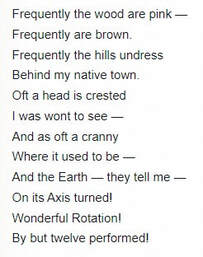 | 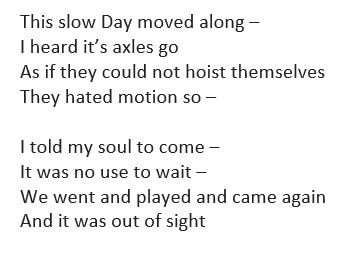 |
In the song, I juxtaposed these two poems because one conveys the rapid passage of time, and the other emphasizes the opposite – until, in its second stanza, it ends with a brilliant twist of irony!
A fourth way to add a bit of “time” to a poem for a longer song is to repeat words, phrases or lines. Dickinson’s poem “Adrift! A little boat adrift!” is relatively short, and I added a bit to it by repeating the word “adrift” and by adding other repeating lines.
A fourth way to add a bit of “time” to a poem for a longer song is to repeat words, phrases or lines. Dickinson’s poem “Adrift! A little boat adrift!” is relatively short, and I added a bit to it by repeating the word “adrift” and by adding other repeating lines.
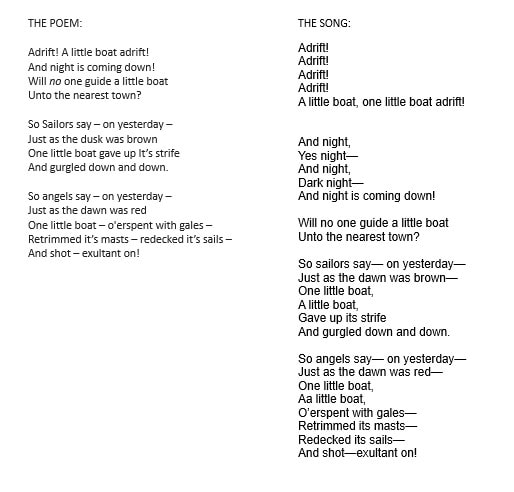
I have one more -- albeit unusual -- way of handling Dickinson's shorter poems when setting them to music. I'll post that soon!
 RSS Feed
